Renegade coming 22nd August 2026 — Pre-order on Amazon!


Beyond the Arena: Why Dystopian Fantasy is Having a Renaissance (And How to Write It)
Dystopian fantasy is evolving. Move beyond 'dark kingdoms' and learn to build a rebellion-fuelled world that bites back with political complexity and deep lore.
WRITING ADVICE
C. Pintilie
6/3/20264 min read
Dystopian fantasy is undergoing a massive transformation. We are officially trading the clean, controlled, teenage arenas of the 2010s for something far more ruthless, complex, and grounded in high-stakes survival.
Readers are craving that raw, rebellion-fueled energy we all fell in love with a decade ago, but the hunger has evolved. We don’t want it simplified anymore. We want political complexity, deep lore, and the sweeping, visceral power of high fantasy blended into the survival story.
Why? Because the real world feels increasingly dystopian. When we write about environmental collapse, encroaching authoritarianism, human rights erosion, or the reckless acceleration of technology, we are mirroring the anxieties of our own generation. Dystopian fantasy is the perfect vehicle for this because it lets you break the world twice: once with magic, and once with power. You get the political decay of a failing empire and the unpredictable danger of dragons. It’s highly efficient, and it’s deeply cathartic.
If you are an author looking to build a dystopian fantasy that doesn’t just feel like a generic "dark kingdom with cloaks," here is how to build a world that bites back.
The Anatomy of the World: 5 Keys to Depth
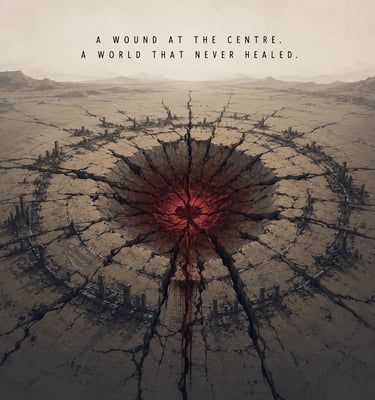
1. Build the "Wound" at the Centre of the World
A strong dystopia is the aftermath of a specific choice. Don't just give us "bad vibes." Ask: What went wrong? Was it an ancient war that poisoned the land? A pact with something monstrous to ensure survival? Immortality that was hoarded by the elite? The wound should be something that people are still paying for generations later.
2. Make Magic Part of the Oppression
If you have magic, don't treat it as window dressing. Tie it to control. Who gets to wield it? Who is taxed for it? If your state tracks and licenses magic, it becomes a tool of surveillance. If it requires blood tribute or shortened lifespans, it becomes a tool of labor exploitation. The best magic systems in dystopia ask: Who is denied access to it?
3. Let Ordinary Life Feel Normal Within the Nightmare
This is the secret to believability. People adapt to horror. If your characters spend every scene contemplating the political upheaval of their nation, it will feel like a lecture. Instead, have them gossip, flirt, complain about their boss, buy black-market bread, or steal little joys. A girl chatting about her ex while she scrubs spell-ink off a floor is more compelling than ten pages of exposition.
4. Give the Regime Internal Logic
The most terrifying villains are the ones who believe they are the heroes. Your ruling power shouldn't just be "evil." Are they protecting order? Purity? Divine law? Survival at any cost? If they believe their brutality is a necessary sacrifice for "the greater good," they become layered, dangerous, and realistic.
5. Decide What the Landscape Remembers
Fantasy worlds should be scarred. Let the environment carry the history of your world. Think of forests where trees whisper the names of the executed, ruined floating cities hanging above starving villages, or rivers glowing with the toxic runoff of old magic. Let the setting feel like a crime scene.
Writing the Rebellion: Structure and Stakes
Give Your Protagonist a Personal Stake
Saving the world is fine, but it’s abstract. Readers care when the rebellion starts small. Does your protagonist want to smuggle medicine into a forbidden district? Are they trying to find a missing sibling? Is it simple revenge? Let the larger rebellion grow naturally out of a small, human need.
Keep Hope Alive (Somewhere)
If your world is all darkness, it will eventually feel flat. Darkness needs contrast to be truly felt. Hope can be tiny: a secret library, a forbidden song passed between generations, or found family in an alleyway. A candle is always brighter in a ruined cathedral.
Drip-Feed Your Lore
This is the most common trap: the Chapter One Info-Dump. Do not force your reader to learn the 700-year history of the Empire on page one. Drop your lore like breadcrumbs. Let readers discover your history through scars, propaganda, overheard conversations, and ruins. Mystery is the engine that pulls a reader to the next chapter.
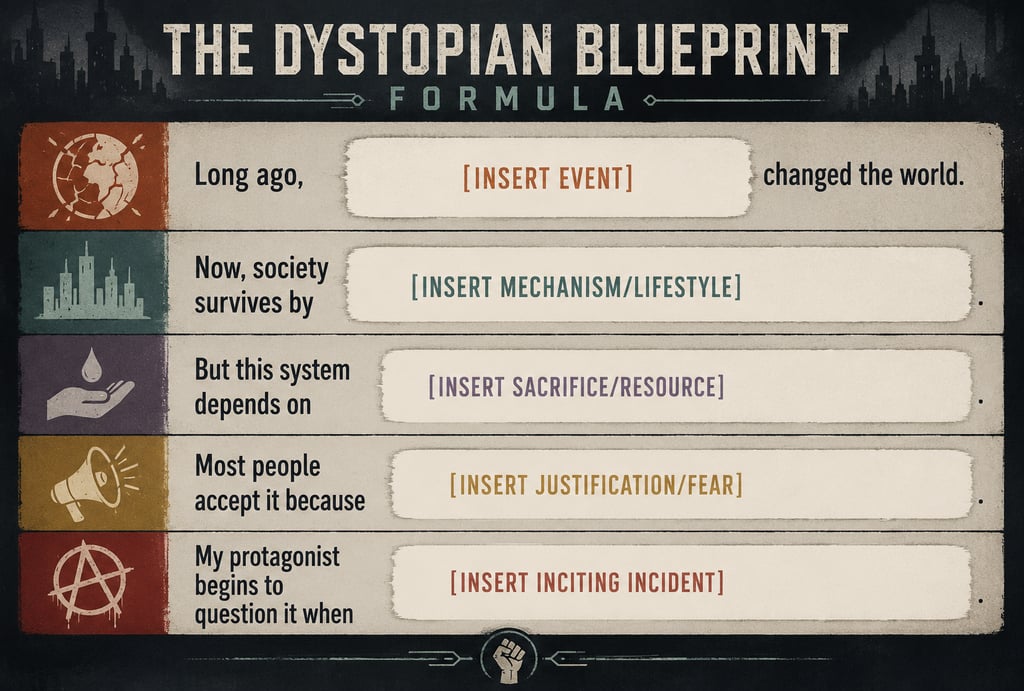
The "Dystopian Blueprint" Formula
If you are staring at a blank page and feeling stuck, try filling out this template. It is a fantastic way to unlock the structural skeleton of a novel:
5 Sparks to Get You Started
Still need a jumping-off point? Try these:
The Harvest: Every citizen is born with one innate spell—but the Crown steals it from them at age sixteen.
The Light Thief: The sun has vanished, and the city’s light is harvested from imprisoned angels.
The Currency of Mind: In a society where memory can be traded as physical currency, the poor are literal shells of their former selves.
The Migration: Monsters aren't attacking the kingdom—they are fleeing from it, because something worse is coming.
The Living City: Magic users are outlawed, but the city itself is sentient and is secretly choosing new wielders to save it from the ruling family.
The renaissance of dystopian fantasy is here because we are looking for reflection, for catharsis, and for a way to map our own anxieties onto a bigger canvas. Whether you are building an empire of ice, a city of gears, or a kingdom of ash—make sure your world has teeth.
What is the one "rebellion trope" you absolutely cannot get enough of?