Renegade coming 22nd August 2026 — Pre-order on Amazon!


Shattering the Mirror: The Academic Writing Rules I Kept (And the Ones I Broke for Dark Fantasy)
Pristine prose isn't enough for dark fantasy. Discover how to 'weaponise' your verbs and strip away academic habits to build tension that truly bites.
WRITING ADVICE
C. Pintilie
5/29/20263 min read
Years of university to earn a BA and an MA in Creative Writing leaves you with a phenomenal toolkit. Academia is fantastic for teaching you how to craft pristine, beautiful prose. It trains you to weave neat, self-contained character arcs and metaphors that make professors weep.
But there is a hard truth you hit the moment you start building a five-book dark fantasy epic: academia doesn't teach you how to sustain structural tension across two million words without your plot completely collapsing under its own weight.
Pristine prose is great, but when you are writing dark fantasy, your sentences need to have teeth. They need to mirror the danger of the setting. If the world you are building is brutal, your writing cannot read like a polite poetry reading. Degrees give you the tools, but the genre dictates the rules.
Here are the top pieces of advice from my creative writing degrees that actually survived the transition to writing Orbis, and how you can apply them to give your own rough drafts a sharper edge.
1. Weaponise Your Nouns and Verbs
In dark fantasy, passive language is an absolute death sentence for pacing. Academic writing often rewards flowery, descriptive passages, but when you are trying to build tension, you need to strip the decorations away and force your base words to do the heavy lifting.
Do not hide behind adverbs. If you have to use an adverb to describe how an action is happening, you chose the wrong verb.
Weak: The shadows moved menacingly across the wall.
Weaponized: The shadows strangled the light.
Weak: He walked aggressively into the tense room.
Weaponised: He trespassed.
To make this work, you must ruthlessly eliminate "filter words." These are words that distance the reader from the protagonist’s immediate experience—phrases like she felt, he saw, they heard, she noticed. Do not write, "Chaelle felt the icy wind bite her skin." Write, "The icy wind bit her skin." Remove the barrier between the reader and the world.
2. Show, Don't Tell (The Death of the Info-Dump)
"Show, don't tell" is the most repeated phrase in any creative writing workshop, but it is rarely explained well in the context of high fantasy. When you have mapped out a 1,200-year geopolitical history and a complex magic system, the temptation to drop a textbook's worth of exposition onto the reader in Chapter One is immense.
Info-dumping kills momentum. Readers do not need to know the entire history of a trade route the moment a character steps onto a road.
Exposition should only ever be a byproduct of action and conflict. Let the reader learn about your world because it is currently actively hindering, hurting, or helping the characters.
Telling: Solis was a harsh, unforgiving place, and Will was lucky to survive leaving it.
Showing: Will rubbed his thumb over the brittle, dried desert rose his brother had pressed into his palm. It was the only piece of Solis he had left, a fragile ward against a world that was already trying to freeze him out.
Trust your readers to piece the lore together. Hide your world-building in the environment, the cultural superstitions, and the scars your characters carry.
3. Freytag’s Pyramid Meets Chekhov’s Razor
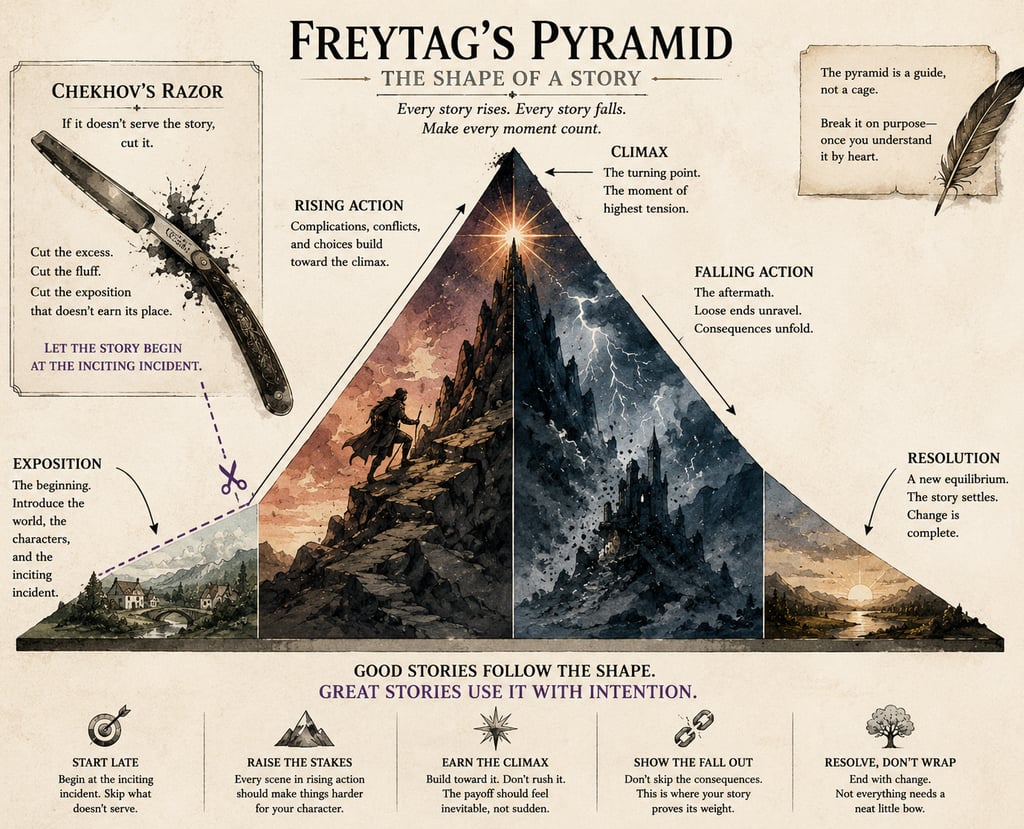
If you study narrative structure, you will inevitably be handed Freytag's Pyramid. It is the classic diagram of a story:
Exposition
Inciting Incident
Rising Action
Climax
Falling Action
Resolution
It works. It is reliable. But Anton Chekhov—one of the greatest structural writers in history—had a very specific, ruthless way of looking at this pyramid. Chekhov famously advised writers to take their completed manuscript, find the exposition at the beginning, and slice it off entirely. Then, go to the resolution at the end, and slice that off too.
Readers do not want to watch your characters pack their bags for the journey. Start in media res—in the middle of the action. Start when the house is already on fire, not when the matches are being purchased. The exposition you cut from the beginning can be drip-fed into the rising action later when the reader actually cares about who is involved.
Combine this structural hacking with Chekhov's Razor (an extension of Chekhov's Gun): If there is a loaded rifle hanging on the wall in chapter one, it absolutely must go off by chapter three. If it doesn't fire, take it off the wall.
Every single scene, dialogue exchange, and descriptive paragraph in a sprawling epic must serve multiple purposes. If a scene only exists to show off a cool piece of world-building but doesn't advance the plot or reveal character depth, it is dead weight. Cut it.