Renegade coming 22nd August 2026 — Pre-order on Amazon!

The Autistic Glass Ceiling: Why Merit Isn't Enough
ADVOCACY & IDENTITY
C. Pintilie
4/29/20264 min read
The Autistic Glass Ceiling: Why Merit Isn't Enough
A 2024 scoping review identified that up to 46% of employed autistic individuals are underemployed or overqualified for their roles. I am one of them. Though autism genetically runs in my family, I wasn't diagnosed until my mid-twenties. By then, I already had a Master's degree and was working as a secondary school teacher. Yet, despite my education, academic capability, and dedication, I found myself repeatedly hitting an invisible barrier—struggling to secure even the most basic reasonable adjustments, let alone actual progression in my career.
Openly autistic leaders are vanishingly rare, creating a lack of role models and perpetuating the belief that advancement is impossible. While disclosure is necessary for accommodations, it frequently results in being pigeonholed into entry-level roles, treated differently, or denied promotions. The glass ceiling is particularly pronounced for women and non-binary autistic people, who face compounded bias, often combined with a late diagnosis, and are rarely represented in leadership roles. Researchers are rightfully calling for a shift from merely getting autistic people hired to focusing on our long-term career trajectories and the creation of inclusive leadership pathways.
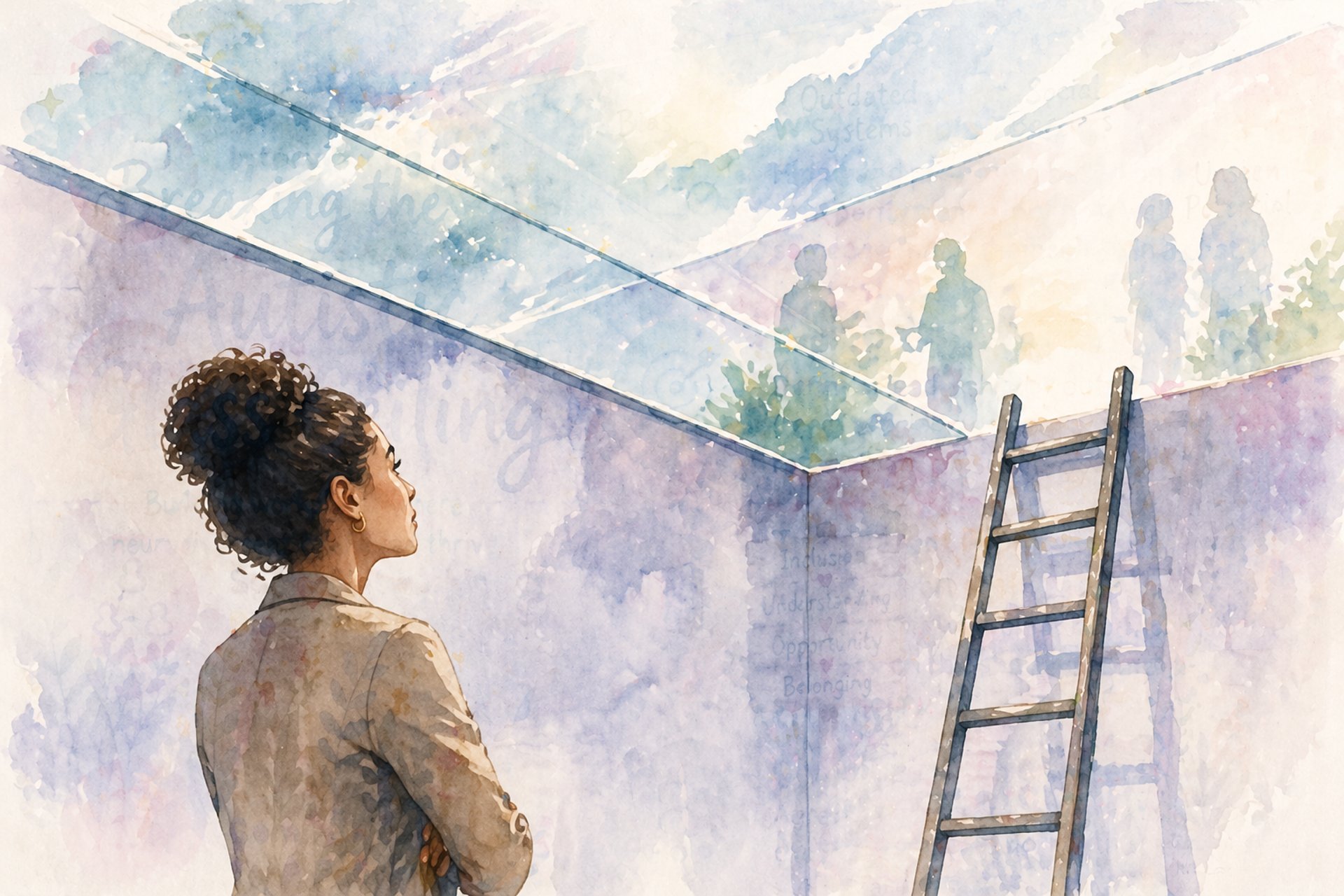
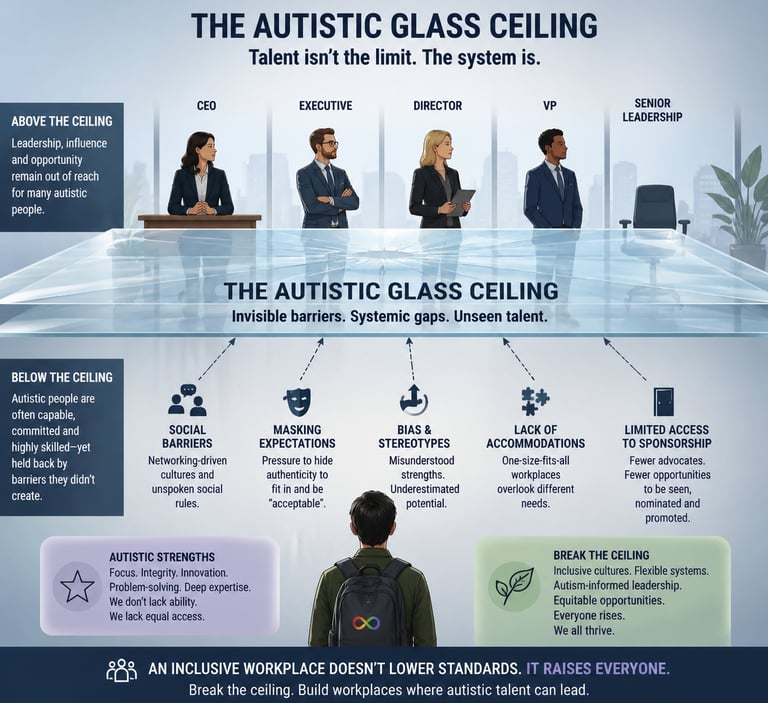
This "Autistic Glass Ceiling" is a sociological and professional phenomenon where autistic individuals, despite possessing high technical competence, superior pattern recognition, and specialised skills, are systematically prevented from advancing to leadership or senior roles. Unlike the traditional glass ceiling—which relies on overt demographic biases like gender or race—ours is built on neuro-normative standards of behaviour, communication, and social dominance.
1. The Structure of the Ceiling
The ceiling is not a single barrier but a series of invisible filters that prioritise social fluency over tangible output.
A. The "Culture Fit" Trap & The Defiant Label
This dynamic starts early. Long before I was a teacher navigating school politics, I was a student who excelled academically but was constantly labelled a "challenging" or "persistently defiant" pupil. I wasn't being defiant; I was an unsupported autistic child. That same fundamental misunderstanding carries over into the workplace. "Culture fit" is often code for "similarity to the dominant neurotype." High-performing autistic employees are passed over for promotions because we don't engage in the informal social bonding—the staff room talk or after-work drinks—that neurotypical leaders use to identify "leadership material." We may have the best metrics on the team, but we are viewed as "not a team player" simply because we prioritise deep work over social maintenance.
B. The Social-Communication Gap
Leadership roles are frequently gated behind "soft skills," which are defined exclusively through a neurotypical lens. Managers expect leaders to communicate using subtext, indirect requests, and diplomatic ambiguity. Just as my teachers misread my directness as insubordination, colleagues misread autistic clarity as aggression or rudeness. We often receive feedback solely on how we communicate (tone, eye contact, bluntness) rather than the content or value of our ideas, stalling our growth in a cycle of "remedial" soft-skills training that forces us to mask rather than lead.
C. The Sensory Gatekeeping of Management
As one climbs the ladder, the environment becomes increasingly hostile to autistic sensory needs. Management roles often involve back-to-back verbal meetings, high-traffic environments, and constant sensory noise. For an autistic person who processes information better via text or needs recovery time after social interaction, this structure is inherently exhausting. Without the reasonable adjustments I fought so hard for, it leads directly to burnout.
2. The Hidden Costs: Why the Ceiling Persists
The "Worker Bee" Pigeonhole
Because autistic employees often excel at specialized, detail-oriented tasks, organizations weaponize this competence. Managers consciously or subconsciously decide that an autistic employee is "too valuable" in their current technical role to promote. We become indispensable as "doers" but are never groomed to be "leaders"—a dynamic known as the competence trap.
The Exhaustion of Masking
"Masking" (camouflaging autistic traits to fit in) is a resource-heavy cognitive process. While a neurotypical employee might spend 10% of their energy on social navigation, an autistic professional spends upwards of 50% just "appearing normal."
I know the cost of this performance intimately. Chronic masking and a total lack of institutional support culminated in a severe six-month burnout. I had to step away from the classroom. I had to delay the publication of my novel. My baseline skills regressed entirely; I developed a new stutter and found myself at a drastically increased risk of debilitating shutdowns and meltdowns. Many autistic professionals hit the glass ceiling not because we lack ability, but because we burn out trying to perform "neurotypical executive presence." The ceiling doesn't just halt our careers—it shatters our health.
3. Intersectionality: The Concrete Ceiling
The glass ceiling is harder to break for autistic people who also belong to other marginalized groups.
Race & Autism: Autistic people of colour are frequently misdiagnosed or viewed as "difficult" or "aggressive" rather than neurodivergent. The leeway given to a white autistic male ("he's just eccentric") is rarely extended to Black or Hispanic autistic employees, who are more likely to face disciplinary action for the same behaviours.
Gender & Autism: Autistic women and non-binary individuals often face a "double bind." The pressure to be socially accommodating is higher; therefore, the failure to perform social niceties is punished far more severely than in male counterparts.
Disability & Autism: The "Dynamic Disability" trap creates a unique barrier for those of us with co-occurring physical or sensory conditions. When an autistic person requires further accessibility for a physical disability, they are often viewed as "too high-maintenance" for leadership. Employers may accommodate a "singular" disability, but when neurodivergence intersects with physical needs, the assumption of incompetence deepens. We are frequently forced to choose which part of our accessibility to fight for, as requesting support for both is often met with the internalised ableist view that we are simply "too broken" to lead.
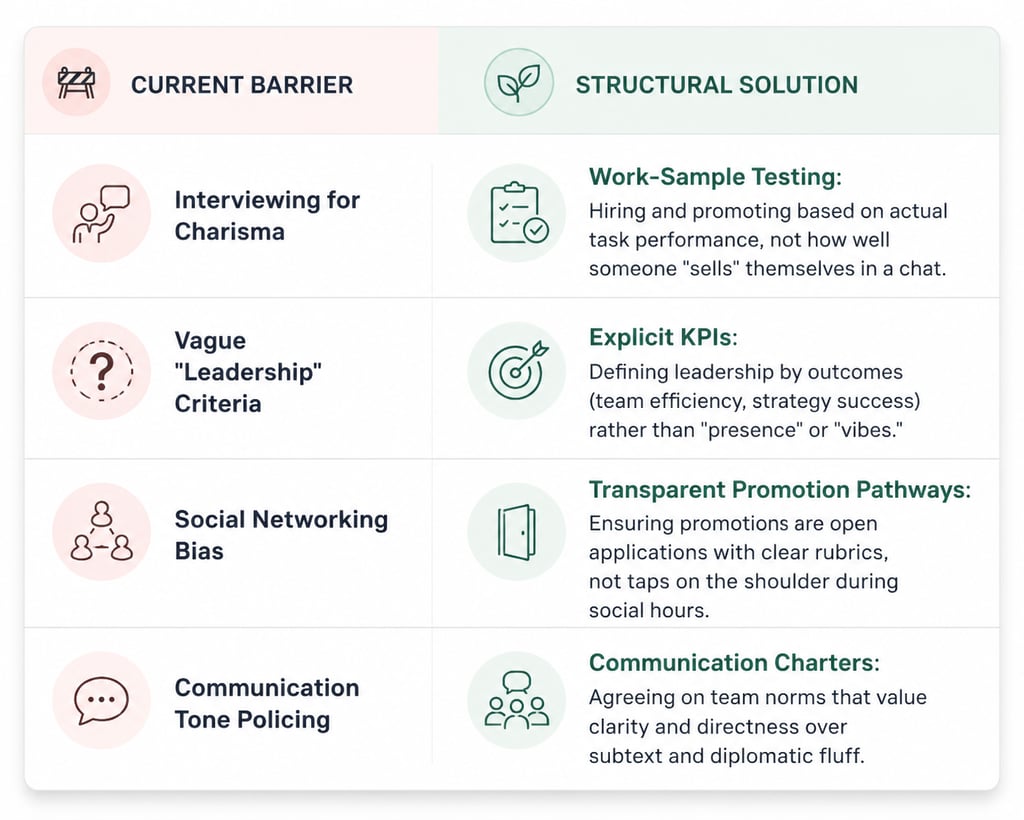
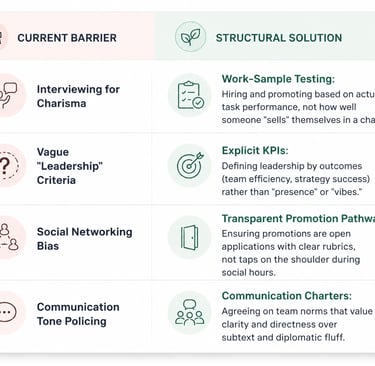
4. Breaking the Ceiling: A Structural Shift
Dismantling this barrier requires moving from "Accommodations" (fixing the person) to "Universal Design" (fixing the system).
Summary
The autistic glass ceiling is effectively a social tax on professional advancement. It demands that autistic people pay a steep cognitive fee—in the form of masking and social performance—to access the same opportunities as our peers. Until organisations value results over social conformity, and recognise that neurodivergence is a natural human variation rather than a deficit to be managed, this ceiling will remain impenetrable for many.