Renegade coming 22nd August 2026 — Pre-order on Amazon!

The Foundations of Shunya-Sabil
C. Pintilie
“To understand the South is to understand the silence between the dunes.”
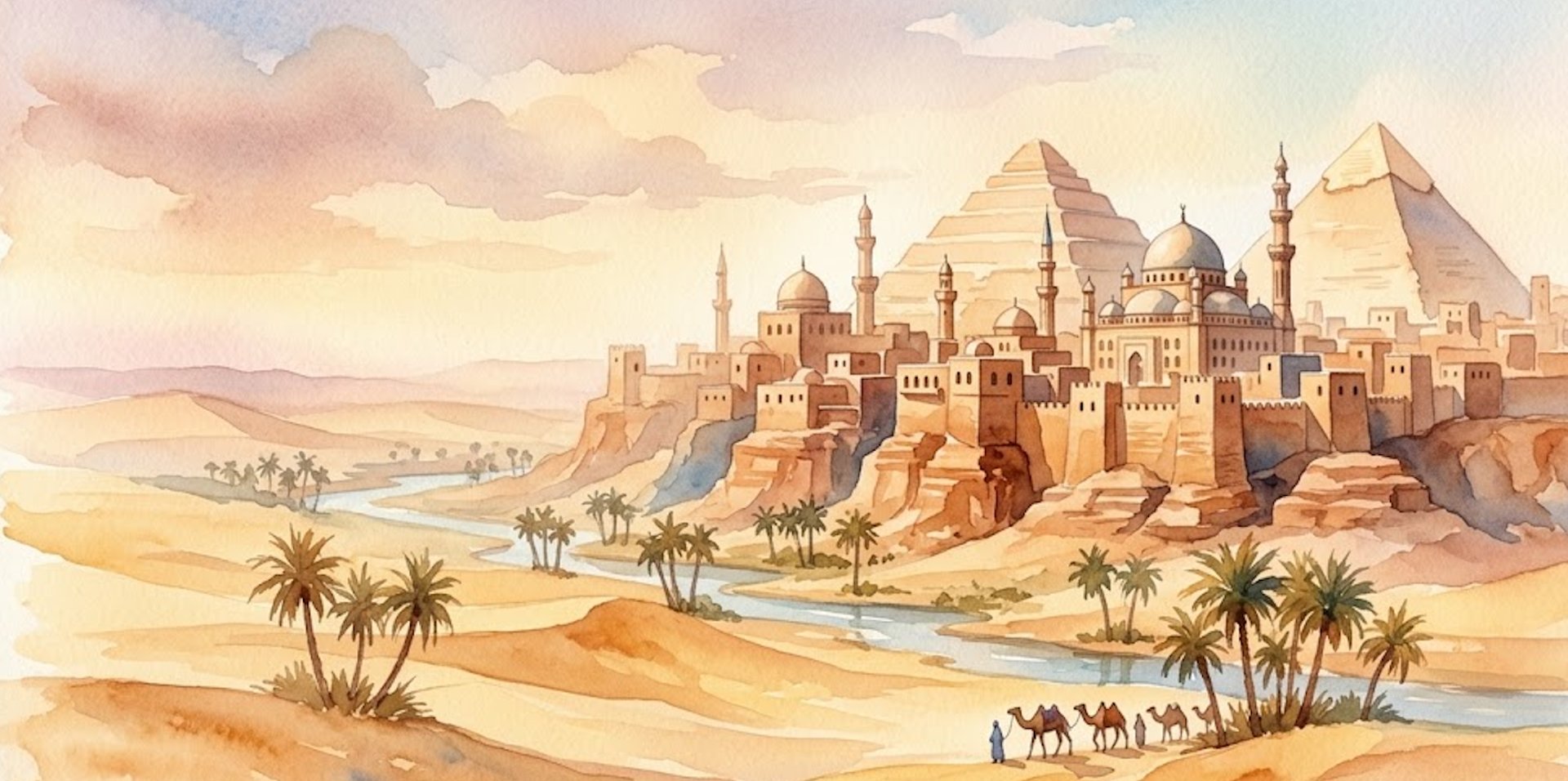
In the first of our deep dives into the cultural foundations of Orbis, we turn our gaze toward the blistering heat of Solis. While the Midlands thrive on coin and the North survives on the land, the people of the South exist in a state of spiritual paradox. They call it Shunya-Sabil—a path that seeks the Infinite through the Void.
The Faith: Shunya-Sabil
In the searing expanse of the South, there is no word for “religion.” There is only Shunya-Sabil—the Path of the Void. It is a belief system built on the paradox of absolute emptiness and infinite presence. It teaches that the world is a temporary reflection of a higher, unmanifested truth. Followers do not seek to “worship” in the traditional sense, but to align their internal frequency with the stillness of the desert.
Unlike the fragmented mythologies of the past, Shunya-Sabil is strictly monotheistic. There are no lesser deities, no demigods, and no spirits to appease. There is only the Source.
The Divine: Oru
In Solis, the word “God” is considered a clumsy, human invention. Instead, the faithful speak of Oru.
Oru is the Name beyond names. Oru is singular, indivisible, and encompasses all things. To the people of the Sandsea, Oru is not a person sitting on a throne, but the very light that creates the shadow and the wind that carves the dunes. When a traveler survives a sandstorm, they do not say “The gods favoured me”; they whisper, “Oru provides.”
The Prophet: Ashraam
The geometry of the faith was defined by Ashraam. He was not a king or a warrior, but a youth of profound stillness. Ashraam is revered as the Great Messenger who bridged the gap between the scorched South and the frozen North.
According to the Archives, Ashraam undertook the Longest Pilgrimage, a journey that remains the bedrock of Shunya-Sabil lore. He walked from the sun-bleached ruins of Solis, through the humid marshes of Magnushire, until he reached the icy, vertical peaks of Aksala. It was during this journey that he received the “Whispers of the One,” teaching the world that Oru is present in the ice just as much as the heat.
The Asceticism of the Messenger
The core of Ashraam’s divinity-touched journey was forged through a period of profound physical and spiritual trial that mirrors the ancient stories of the enlightened. During the middle years of his pilgrimage, it is written that Ashraam retreated into the high-altitude silence of the Aksala peaks, where he committed himself to a total renunciation of the flesh. He entered a state of sustained asceticism, starving himself until his body was as gaunt as the desert thorns, surviving on nothing but the melting frost and the absolute conviction of his faith. In this hollowed state, he spent moons in unmoving meditation, his prayers becoming a continuous, silent thread that tied his spirit to the presence of Oru. It was only after this total emptying of the self—this literal “Shunya”—that he achieved the clarity required to receive the final tenets of Shunya-Sabil, proving that the path to the Infinite is found only when the demands of the body are silenced.
The Practice: A Triad of Devotion
Shunya-Sabil is a “Grounded” faith, blending the physical and the metaphysical into a rigorous daily life:
Meditation (The Shunya): Borrowing from the ancient ways of the Mind, followers spend hours in silent meditation. They seek to reach “Shunya”—the state of zero—where the ego dissolves, leaving only the connection to Oru.
The Shrines (The Ashraam-Stambha): Despite the lack of icons, the landscape is dotted with shrines. These are not houses for idols, but geometric markers of stone and sand where the veil between worlds is thin. The shrines are places of high energy where the faithful leave offerings of salt or dried desert roses.
Prayer (The Sabil-Salah): The followers of Shunya-Sabil engage in frequent, rhythmic prayer. Three times a day, regardless of where they are in the Sandsea, they face the direction of Ashraam’s first footstep to acknowledge the sovereignty of Oru.
The Void and the Horizon
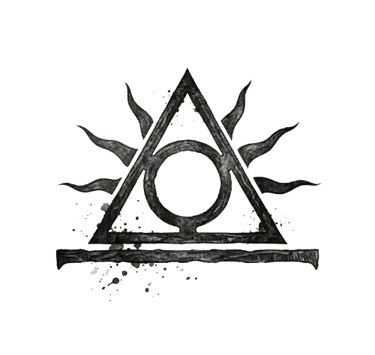
This symbol captures the core of Oru as defined in Shunya-Sabil: the “Path of the Void.”
This symbol captures the core of Oru as defined in Shunya-Sabil: the “Path of the Void.”
The Geometry: The upward-pointing triangle (pyramid) represents the rigid, architectural history of Solis. It signifies the structures humans build—the temples and the ego—but it remains open and unconfined at the tip.
The Inner Void: At the centre, there is a perfect circle of negative space (The Shunya). This is not an empty circle; it is the presence of Oru—the singularity that is both absolute emptiness and infinite presence. It cannot be touched, only surrounded by the structures of faith.
The Solar Crown: The undulating, wild rays breaking free from the upper edges are not just the “sun.” They represent the “Unmanifested Light”—the power of Oru that transcends the heat of the desert.