Renegade coming 22nd August 2026 — Pre-order on Amazon!


The Hyperfocus Timeline: World-Building, Burnout, and the Reality of the Autistic Brain
Hyperfocus is my writing superpower, but it comes at a heavy physical cost. I’m sharing how I built my dark fantasy world and the reality of autistic burnout.
ADVOCACY & IDENTITY
C. Pintilie
6/1/20263 min read
If you were to look at my desk right now, you would probably think I’m investigating a massive, century-spanning conspiracy. There are notebooks piled precariously high, a whiteboard covered in chaotic, branching timelines, and at least forty browser tabs open to things like medieval blacksmithing temperatures and historical climate data.
To the outside world, it looks like an over-complicated, unhinged rabbit hole. To me, it’s just a Tuesday.
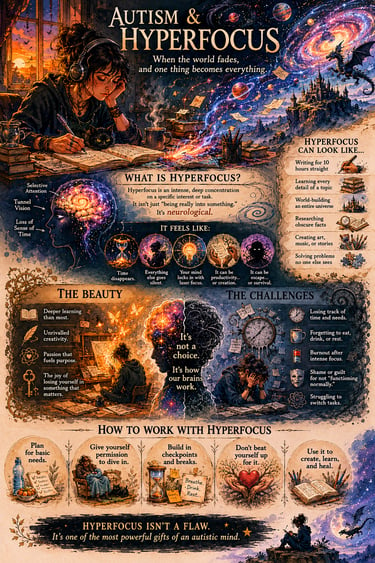
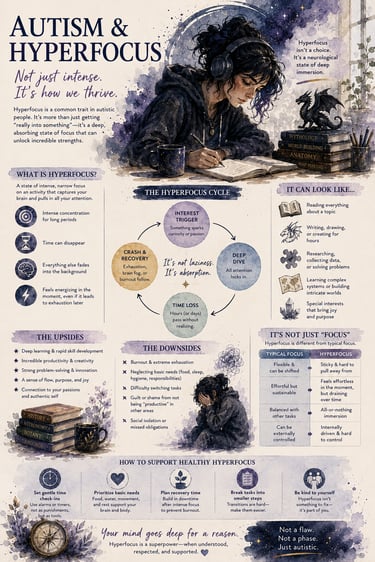
One of the most defining aspects of being an autistic author is the absolute, uncompromising weight of hyperfocus. In a world that often treats neurodivergence like a deficit, this ability to dive into a special interest is my absolute superpower as a writer. It is the engine behind my five-book dark fantasy epic. My brain simply will not allow me to leave a single loose thread, which means the lore of my world has a level of structural depth I could never fake.
But it’s a double-edged sword. Here are the things my autism hyperfocus absolutely forced me to fully map out before I even wrote Chapter One—and the very real physical toll that comes with doing it.
The "Unnecessary" Details That Make the World Breathe
When I sit down to build a world, my brain doesn't accept "because magic" as an answer. It demands structural integrity. Before the plot could even begin, I found myself deep in the trenches of these hyper-specific rabbit holes:
The 1,200-Year Geopolitical Timeline: I didn't just decide there was tension between Solis and Magnushire. I mapped out a literal twelve-hundred-year history detailing every minor border dispute, treaty, and resource war. Did the actual plot need it? No. Did my brain need to know exactly why the trade routes shifted in the year 412 to justify a passing comment in chapter three? Absolutely.
The Granular Emotional Artifacts: Hyperfocus means you cannot just hand a character an object; that object needs an entire anatomical history. When Will left Solis, his little brother gave him a dried desert rose for protection. My brain demanded I know the exact botanical preservation process, how the brittle petals would feel against Will's thumb in the cold, and the specific folklore of that region that made a child believe a dead flower could keep his brother safe.
The Sensory Map of the Aksala Mines: I didn't just map the geography of the mines. I needed to know the exact auditory resonance of pickaxes striking frost-bitten stone. I needed to understand how that specific, echoing frequency bounces off the cavern walls and triggers my main character's survival instincts.
The Thermodynamics of Orbis: In my world, the climate is being weaponized. But if the weather is actively trying to kill my characters, the physics of that weather pattern better be flawless. I spent days mapping out the thermodynamic logic of the atmosphere.
When my characters, like Chaelle, interact with this world, it doesn't just feel like a story setting. Because of my hyperfocus, it feels like a living, breathing reality with consequences.
The Dark Side of the Superpower
It is easy to romanticize hyperfocus online. It makes for great TikTok videos to joke about staying up until 3 AM researching historical sword pommels. But the clinical reality of autistic hyperfocus is rarely glamorous, and it is vital to talk about the physical cost of it.
When my brain locks onto a world-building puzzle, the rest of the physical world ceases to exist. Hyperfocus often looks like completely neglecting basic human needs. It means looking up at the clock and realizing I haven't eaten a single bite of food, drank a glass of water, or even used the toilet in eight straight hours because I was too engaged with what I was doing. The physical sensation of hunger or a full bladder is completely overridden by the neurological demand to finish the thought.
This is heavily compounded by the agony of task-switching. For an autistic brain, shifting gears from a state of deep, immersive hyperfocus into a mundane task—like making lunch or answering an email—feels physically painful. It’s like trying to derail a freight train going 100 miles an hour. The friction of trying to force my brain to stop doing the thing it is obsessed with and start doing something "normal" takes a massive amount of cognitive energy.
The Inevitable Crash
You cannot run an engine at maximum capacity without coolant forever. The inevitable result of these intense, immersive world-building sessions is severe autistic burnout.
When the hyperfocus finally breaks, it doesn't just leave me feeling a bit tired; it drains my battery to zero. The cognitive load of ignoring my body’s signals, combined with the sheer neurological output of creating an entire universe, often leaves me completely depleted. It’s a vicious cycle of brilliant, uninhibited creation followed by periods where just processing a loud noise or making a cup of tea feels like climbing a mountain.
Embracing the Chaos
Being a neurodivergent writer means constantly navigating this extreme pendulum swing. I have to actively set alarms to remind myself to drink water, and I have to forcefully close my laptop before the burnout takes hold.
But despite the heavy physical toll, I wouldn't trade this brain for anything. This meticulous, sprawling, unyielding obsession with the details is what makes Orbis real. It is what makes the characters bleed, the magic systems hold weight, and the world feel ancient.
To my fellow neurospicy creatives: I know I am not alone in this. What is the most incredibly specific, unhinged rabbit hole your hyperfocus has dragged you down for your current project?