Renegade coming 22nd August 2026 — Pre-order on Amazon!

The Illusion of Inclusion
C. Pintilie
4/30/20265 min read
The Reality of Being an Autistic Educator
It wasn’t until 2023, after years of chronic masking and quiet exhaustion, that I finally received my autism diagnosis. For seven years prior, I had been carrying the weight of a 2016 misdiagnosis of EUPD—a label that offered no real answers and certainly no support.
I’ve spent the last six years working across the education sector: as a primary school TA, an academic mentor tutoring KS3 literacy and Fresh Start Phonics, a TA in a specialist SEND school, and now a KS3 and KS4 teacher. I have seen the education system from almost every angle. And what I’ve learned is that there is a staggering, heartbreaking disconnect between the values schools put on their prospectuses and the reality of their staff rooms.
The Performative Preaching
Walk down any school corridor and you will see posters championing diversity. Open any staff handbook and you will read policies on inclusivity. But as a disabled and autistic educator, the reality is starkly different.
Schools preach inclusivity, but it’s performative.
Schools preach diversity, but only if you fit neatly into their "culture box."
Schools preach support, only to rely entirely on goodwill hours to keep the system running.
When you ask for help, the mask slips. Early in my career as a primary school TA, I asked for support with my mental health. I was explicitly told I "shouldn't talk about that." When I took necessary time off, the headteacher wrote me a damning personal reference that lost me my place on Teach First. I had to delay my career by a full year, fighting through ACAS just to secure a settlement and a fair reference.
You might think a specialist SEND school for autism would be different. It wasn’t. While going through my diagnosis, I disclosed my situation. I received zero accommodations. Instead, I was chastised, told my autistic behaviors were "unprofessional," and offered no assistance.
The Toxic Staff Room and "Disability Privilege"
The staff room often mirrors the very worst of the high school hallways. In the four schools I’ve worked in, I have consistently witnessed a toxic, clique-like culture—ranging from mild to severe.
In these environments, reasonable adjustments for invisible illnesses or neurodivergence aren't viewed as legal requirements to level the playing field. They are viewed by other staff members with jealousy and treated as "disability privileges."
Management often knows very little about equality and employment law, or they actively choose to ignore it. They rely on continuous Occupational Health referrals instead of implementing actual adjustments. When they do agree to adjustments, they keep them informal so they don't have to be maintained. Grievances are delayed indefinitely. The process is weaponised against employees in order to wear them down by attrition.
It’s an environment that breeds isolation and burnout, and I am not the only casualty:
The Autistic Carer: One colleague, also autistic and a carer, was forced out due to burnout and lack of adjustments. During a work night out, her communication style naturally mirrored an LGBTQIA+ coworker who was jokingly calling people "sexy." When she accidentally tripped and fell on someone, this mirroring and her clumsiness were weaponised against her, leading to an accusation of sexual assault.
The Double Standard: Another colleague with a physical disability was denied basic adjustments while going through a divorce with children. Meanwhile, a non-disabled coworker in a similar life situation was gifted class changes, timetable reductions, and endless support.
The Progression Wall
If you don't fit the mold, your career progression is gated. Despite holding a Master's degree, I was denied an internal TLR. Management claimed it was because I lacked an NPQ—a qualification they flat-out refused to offer me, despite my stated desire to progress. When I tried to move laterally within the trust to find better footing, I was blocked and told, "You won't get progression where people don't know you."
Yet, the outside world sees what my own trust refuses to. When I mask heavily, I get results. I recently applied for a Second in Department role outside the trust and made it to the final two. I applied for a college course leader role, was the second applicant accepted for an interview out of many, and only missed out because I lacked KS5 teaching experience. The ceiling isn't my capability; the ceiling is their culture.
The Paradox: Why Neurodivergent Teachers Are Essential
Here is the greatest irony of it all: the very traits that make management view me as "unprofessional" or "difficult" are exactly what make me a lifeline to my students.
While the system undervalues us, the kids do not. As an autistic educator, I bring strengths to the classroom that cannot be taught in a CPD session:
Academic Excellence: I consistently achieve the highest rate of academic progress and outcomes among my pupils, particularly for SEND and nurture groups.
Deep Rapport: I can sense micro-changes in a student's emotional state before behavior escalates.
Regulation: I don't just demand compliance; I teach regulation skills and actively co-regulate with my students.
Understanding "Challenging" Behavior: I am able to engage children labeled as "difficult" because I recognize that their behavior is usually rooted in trauma, pastoral issues, or undiagnosed SEND.
A Safe Space: I am the person students disclose things to. By actively advocating for autism and disabilities, I help students find the courage to open up about their own experiences.
On World Teacher Day, while most teachers received zero or one card, I received 45. I am often called the "favorite teacher," not because I am easy, but because I am authentic, safe, and understanding.
I stood firmly in my identity as an openly autistic and disabled educator, refusing to hide my fibromyalgia or neurodivergence behind a mask. My goal was to be the visible representation I never had: a successful, high-achieving teacher who navigated the world differently. By being transparent with both staff and students, I transformed my classroom into a living case study for disability rights and radical acceptance. I didn't just teach the curriculum; I modeled how to advocate for reasonable adjustments and spoke openly about the importance of accessibility. I wanted my students to see that being neurodivergent isn't a barrier to success, but a perspective that brings unique value to a community—proving that our "differences" are often the very things that allow us to connect, empathize, and lead most effectively.
We are burning out not because we can't handle the children, but because we can't handle the systemic hypocrisy. Neurodivergent and disabled educators are the very people the education system desperately needs to reach its most vulnerable students. It is time schools stopped just preaching inclusivity, and started actually practicing it.
Key Findings on Neurodivergent Teachers
Role Differences: While one-quarter of classroom teachers identify as neurodivergent, this figure drops to 17% among senior leaders, suggesting a potential barrier to career progression. [1]
Age Factor: Younger teachers identify at higher rates, with 30% of teachers in their twenties and thirties identifying as neurodivergent, compared to 22% of those over 40. [1]
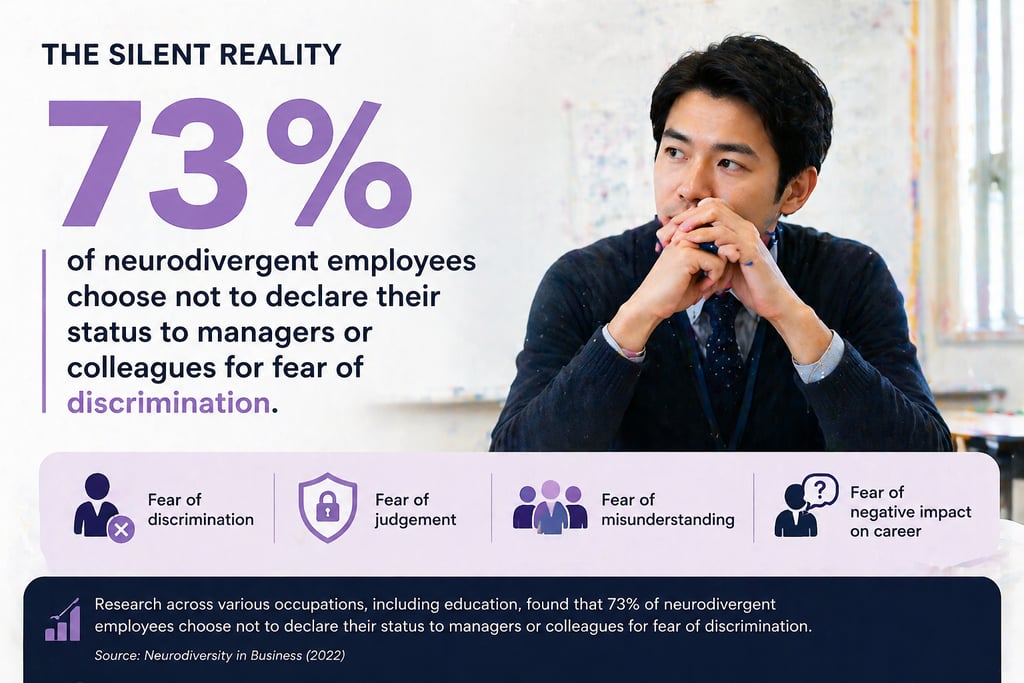
"Invisible" Workforce: Many neurodivergent teachers have been "invisible" in the workforce, and while many are open, others still choose not to disclose their status due to fear of discrimination. [1, 2]
Why the High Percentage? The teaching profession often attracts neurodivergent individuals because the fast-paced, highly structured environment can suit ADHD or autistic traits. [1]
While roughly 25% of teachers identify as neurodivergent, research suggests that the majority do not disclose their status to students or senior staff due to fear of stigma and discrimination. [1, 2, 3]
Reasons for Secrecy: In broader workplace studies, 31% to 67% of neurodivergent employees choose not to tell their managers. Common reasons include:
Disclosure to Students
A "Dilemma" of Openness: There is no official national data on how many teachers are open with students, but academic research describes it as a significant "disclosure dilemma". [1, 2]
Limited Transparency: Data from similar professional fields (like higher education) suggests that only about 20% of neurodivergent instructors who have disclosed to their campus actually share that information with their students. [1]
Professional Identity: Many teachers feel pressure to "mask"—suppressing their natural traits to behave in a way deemed "appropriate" or "professional" by neurotypical standards—which often prevents them from being open with their classes. [1, 2]