Renegade coming 22nd August 2026 — Pre-order on Amazon!

The Only Place I Can Breathe Out Loud: On Late-Diagnosed Autism, Fibromyalgia, and Unmasking Through Fiction
From chronic masking to fibromyalgia: I’m sharing my journey as a late-diagnosed autistic author and why writing fiction is the only place I can finally be myself.
ADVOCACY & IDENTITYBEHIND THE SCENES
C. Pintilie
5/31/20263 min read
The Only Place I Can Breathe Out Loud: On Late-Diagnosed Autism, Fibromyalgia, and Unmasking Through Fiction
If you look at my social media, you might see a put-together author talking about world-building templates or sharing book recommendations. But the truth is, the most unexpected part of being an autistic author is realizing that writing dark fantasy is the only place in my life where I am completely, unapologetically unmasked.
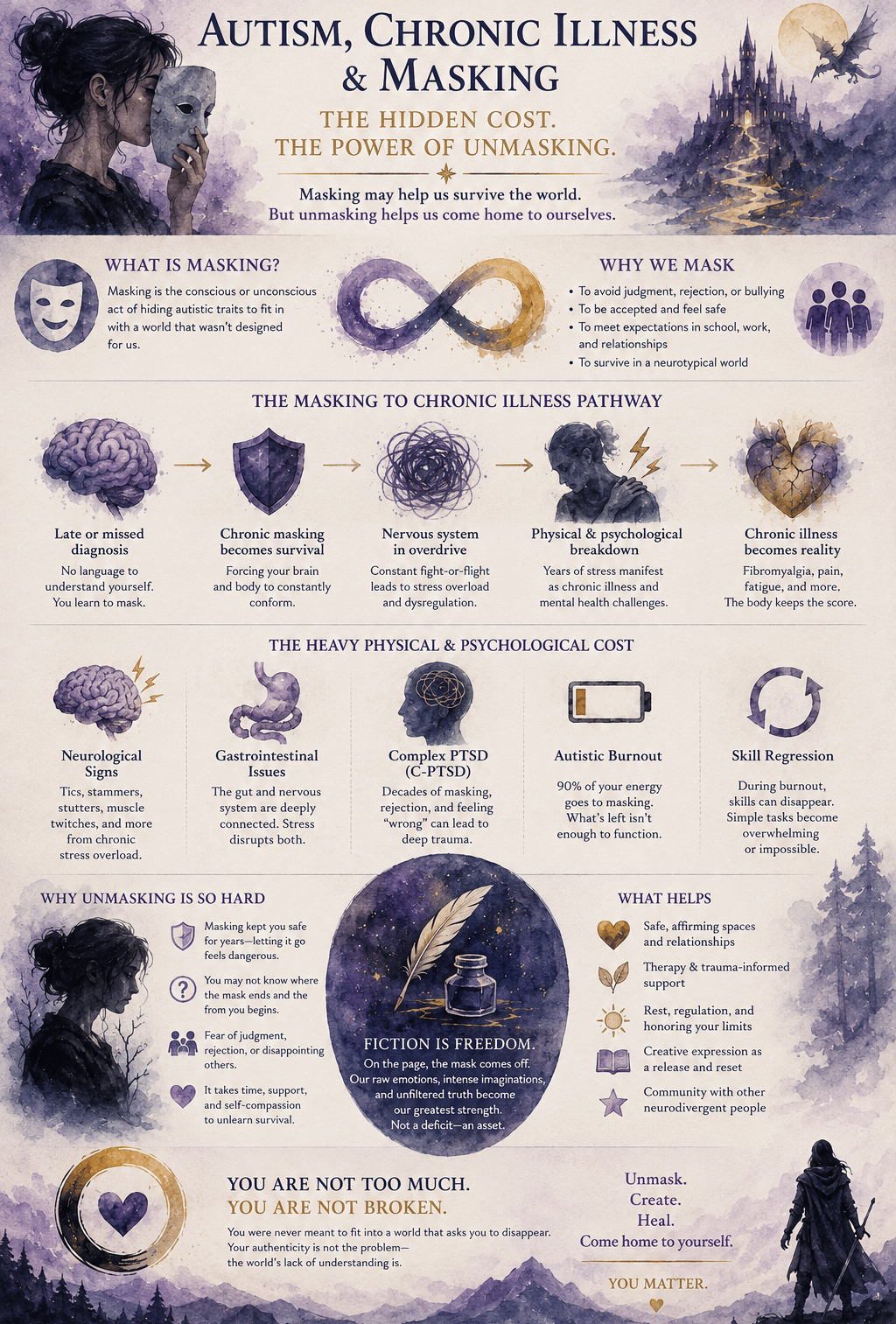
In the real world, masking isn't a choice; it’s a survival mechanism. We constantly calculate our facial expressions, monitor our tone of voice, overanalyze our body language, and suppress our natural responses just to fit into a neurotypical society. It is utterly exhausting.
But when I open my manuscript and step into my fantasy world? The mask completely comes off. In fiction, I don’t have to be polite. I don't have to filter the intensity of human emotion. I can pour all of that raw, unfiltered sensory processing and visceral feeling directly into my characters.
The path to finding that safe space on the page, however, was paved by a lifetime of chronic masking—and the severe physical and psychological toll that comes with it.
The Reality of Late Diagnosis: Surviving the "Weird" Label
Chronic masking is almost always a direct consequence of a missed or late diagnosis. When you grow up without the language to understand your autistic brain, you don't know why you are different—you just know that the world finds your natural state unacceptable.
As a kid, I was constantly referred to as strange, odd, weird, or a freak. When you are repeatedly handed those labels by the people around you, you learn to adapt. For me, that meant leaning heavily into becoming an "alternative" person. If society was going to label me as different anyway, I wanted to control the narrative of why I was different.
But beneath that alternative exterior was a massive, ongoing identity crisis. I was trapped in a cycle of constantly changing my personality, my persona, or my look just to see what would stick. It stemmed from a radical, desperate desire for acceptance—a vulnerability that unfortunately led me straight into toxic situations and relationships because I didn't know how to advocate for my true self.
The Heavy Physical Cost: From Masking to Fibromyalgia
You cannot constantly suppress your biology without your body keeping the score. Chronic masking means keeping your nervous system in a permanent state of fight-or-flight, and over the decades, that psychological trauma begins to manifest physically.
I firmly believe that my years of relentless, chronic masking directly caused my fibromyalgia. When you force your brain to constantly police your body, your nervous system eventually short-circuits. The chronic mental load translates into physical pain, profound fatigue, and systemic dysfunction.
It doesn't stop at chronic pain, either. The toll of hiding your neurodivergence frequently causes neurological and physical warning signs:
Neurological tics, stammers, stutters, and muscle twitches as your brain struggles under the weight of the mask.
Severe gastrointestinal problems, because the gut and the nervous system are intrinsically linked.
Complex PTSD (C-PTSD): The trauma of spending decades believing that your natural existence is inherently wrong or unsafe often results in a deep overlap with C-PTSD.
This constant, high-alert state inevitably leads to brutal cycles of autistic burnout. Because your brain is expending 90% of its energy just pretending to be neurotypical, you run out of fuel for basic survival. These periods of burnout aren't just "being tired"—they cause severe skill regression, where things you could easily do last week suddenly become completely impossible.
Why Unmasking is a Battlefield
People often say, "Well, now that you know you’re autistic, why don't you just stop masking?" If only it were that simple. Unmasking is incredibly difficult, and for many late-diagnosed adults, it feels terrifying. Why? Because you have spent twenty, thirty, or forty years building a defense mechanism that kept you safe from rejection and bullying. Stripping that away feels like walking out into a storm without skin.
When you’ve spent your life changing your persona to survive, you genuinely don’t know where the mask ends and the "real you" begins. It requires peeling back layers of internal trauma, tolerating the discomfort of people realizing you aren't who they thought you were, and learning to sit with your raw, unfiltered traits without shame.
Fiction as the Ultimate Liberation
This brings me back to the page, and why my debut novel is so close to my heart.
When my main character, Chaelle, rages against the system in Aksala, or when she refuses to shrink herself to make powerful, comfortable people happy... that isn't just a convenient plot point. That is me letting out the loud, defiant, unmasked voice that society tells neurodivergent people to keep quiet.
Fiction isn't just a fun escape from reality. For a lot of neurodivergent writers, it is a clinical necessity. It is the only place where our intense sensory processing is an asset, not a deficit. It is the one room where we can finally take off the heavy armor, drop our shoulders, and breathe out loud.
To my fellow neurospicy creatives and readers: Do you find it easier to express your true, raw self through your creative outlets than you do in daily life?