Renegade coming 22nd August 2026 — Pre-order on Amazon!

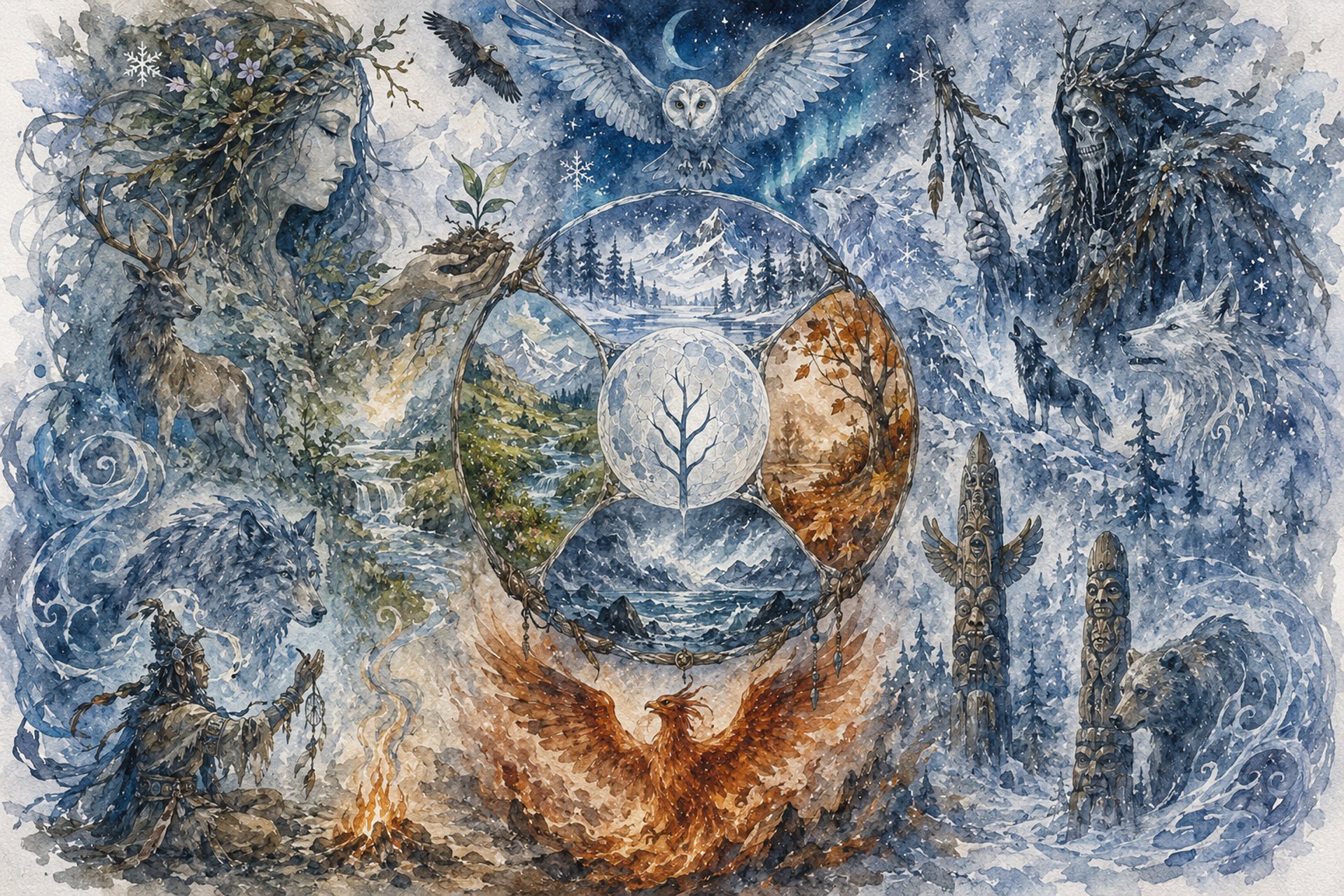
The Weave of Animism
Dive into The Orbis Archives: Aksala Division – The Weave of Animism, an exploration of the ancient spiritual beliefs of the Aksalan people. Rooted in radical animism, their world is alive with spirit—where mountains breathe, rivers remember, and every living thing carries an Anima. From the Winter Solstice Vision rite and elemental veneration to the legends of Ankaa the Phoenix and Loowit of Mount Incendia, this entry uncovers a belief system shaped by endurance, rebirth, nature, and the sacred cycle of the seasons. A journey into myth, survival, and the unseen threads connecting all life.
C. Pintilie
5/24/20264 min read
The Orbis Archives: Aksala Division
The Weave of Animism
The Faith: Animant-Ankaa
In the vertical frost-lands of the North, there is no "Path of the Void." The people of Aksala do not look for a higher truth in emptiness; they find it in the overwhelming fullness of the world around them. Their belief system is one of Radical Animism. To an Aksalani, the world is a crowded place: every jagged peak, every frozen stream, and even the smallest blade of grass possesses an "Anima"—a living, breathing spirit that must be respected and bargained with.
The Rite of Passage: The Solstice Vision
The central pillar of Aksalan life is the Winter Solstice. Before the scars of invasion changed their landscape, this was the sacred time of the "Great Emptying."
To transition from child to adult, an Aksalani must venture into the wilderness alone. They go without food, without sleep, and often without weapons, stripping away the physical self to see the metaphysical. The goal is to survive the elements long enough to trigger a Vision of the Inner Spirit. It is a test of endurance and spiritual receptivity, a moment where the individual’s spirit communicates directly with the "Anima" of the world.
The Dual Sovereigns: Mother Earth & Opiyel
While the South recognises only one Source, Aksala balances upon the scales of two primary forces:
Mother Earth (The Giver): The deity of Life, growth, and the blooming tundra. She is the soil beneath the snow and the warmth in the blood.
Opiyel (The Reaper): The deity of Death and the Great Silence. Opiyel is not viewed as evil, but as a necessary gardener. He is the frost that kills the weak so the strong may survive the winter. He is the ending that allows for a new beginning.
The Totems & Elements
The history of a tribe is carved into Totem Poles—towering cedar monuments that act as spiritual anchors. Each carving represents a pact made between a family and a specific Spirit Animal.
Spirit Animals: These are guides that choose a human during their Solstice Vision. Whether it is the Owl of the Peaks or the Wolf of the Glaciers, the animal defines the individual's role in the tribe.
Elemental Veneration: The Aksalani worship the Wind to carry their arrows, the Fire to keep Opiyel’s cold at bay, the Water to feed life, and the Earth to provide all their needs.
The Cycle of the Four Sovereigns
While the climate of the North remains locked in a near-perpetual frost, the Aksalani believe that the subtle shifts in the air are the movements of four distinct deities. To them, the Change of the Seasons is not a mere weather pattern, but a divine rotation of power:
Spring (The Rejuvenator): A brief but holy window where the goddess of growth restores the nourishment required to sustain life from the frozen earth.
Summer (The Thaw): A fleeting spirit that retreats to the southernmost borders, thawing the permafrost just enough to reveal the emerald grasses beneath the white.
Autumn (The Harbinger): The deity of transition, whose cooling winds serve as a somber reminder that all things—empires and men alike—must eventually age and wither.
Winter (The Tyrant): The most dominant of the four, an inescapable and harsh ruler who demands total endurance from all living things for the majority of the year.
The Tale of Ankaa: The Phoenix
Central to Aksalan philosophy is the story of Ankaa. Unlike the birds of the South, Ankaa is a creature of pure elemental fire.
The story of Ankaa is the Aksalan answer to suffering. It teaches that for the spirit to truly grow, it must occasionally be reduced to ash. Rebirth is not a gift, but a cycle—much like the seasons. When an Aksalani faces a great loss, they say, "Remember the Ankaa," acknowledging that from the charred remains of their old life, a stronger, more vibrant spirit will inevitably rise.
The Legend of Loowit: The Guardian of Mount Incendia
In the oral traditions of the Aksala Division, the most jagged and volatile peak in the northern range is not merely stone, but a sleeping sentinel known as Mount Incendia. According to the elders, the mountain was once a maiden named Loowit, a figure of such radiant spirit that she caught the eye of the Great Creator, Sahale.
The Tale of the Two Suitors Loowit was besieged by the affections of two powerful warrior-brothers: Kaelen, the Lord of the Glaciers, and Varrick, the Master of the Iron Woods. Their rivalry grew so fierce that it fractured the very foundations of the earth; their jealous battles brought fire to the forests and ice to the valleys, destroying the sacred hunting grounds of the Aksalani people.
The Eternal Transformation Unable to choose between them and weary of the blood spilled in her name, Loowit pleaded with Sahale to end the strife. The Creator, seeing the devastation caused by the brothers' obsession, transformed all three into stone.
The Brothers: Kaelen and Varrick were turned into the lesser, flanking peaks, forever frozen in their standoff.
The Fire Goddess: Loowit was transformed into the tallest, most beautiful volcano—Mount Incendia.
To this day, she remains a Fire Goddess in stone, tasked with watching over the land to ensure peace. However, the Aksalani believe that when the mountain smokes, it is Loowit’s heart burning with the memory of the brothers' conflict, reminding the tribes that even the most beautiful passion can lead to total destruction if not tempered by the stillness of the spirit.
Archivist’s Note on Iconography
While the Solis Division uses the 'Void-Triangle,' the Aksala Division is defined by the Circle of the Seasons. Their symbols are fluid, often depicted as wood-carved rings or stone-stacked cairns. To them, the universe is not a point of light, but a web of interconnected lives.