Renegade coming 22nd August 2026 — Pre-order on Amazon!

Travellers of Orbis: The Tragic History of the Umbral Nomads
Dive into the rich fantasy lore of Orbis. Learn the hidden origins of the Travellers, their genetic ties to Solis and Magnushire, and their modern struggle. Discover the tragic, forgotten history of the Umbral Nomads in Orbis. Born from a great convergence, they are the ultimate outcasts belonging everywhere and nowhere.
THE ORBIS ARCHIVES
C. Pintilie
5/20/20264 min read
Every fantasy world has its wanderers, but in Orbis, the nomadic Travellers are not just a people without a home—they are a living, breathing monument to a world that no longer exists.
Hunted by Vortigen’s iron regime in Magnushire, trapped and despised behind the Golden Gates of Solis, and braving the fatal blizzards of Aksala, these dark-skinned nomads are the ultimate outcasts. But the deepest tragedy of their existence is a truth even they have forgotten: they are the only true blood-heirs to the entire continent.
Here is the forgotten history of the Travelers, from the Great Convergence to the Great Amnesia.
The Origin: The Children of the Great Convergence
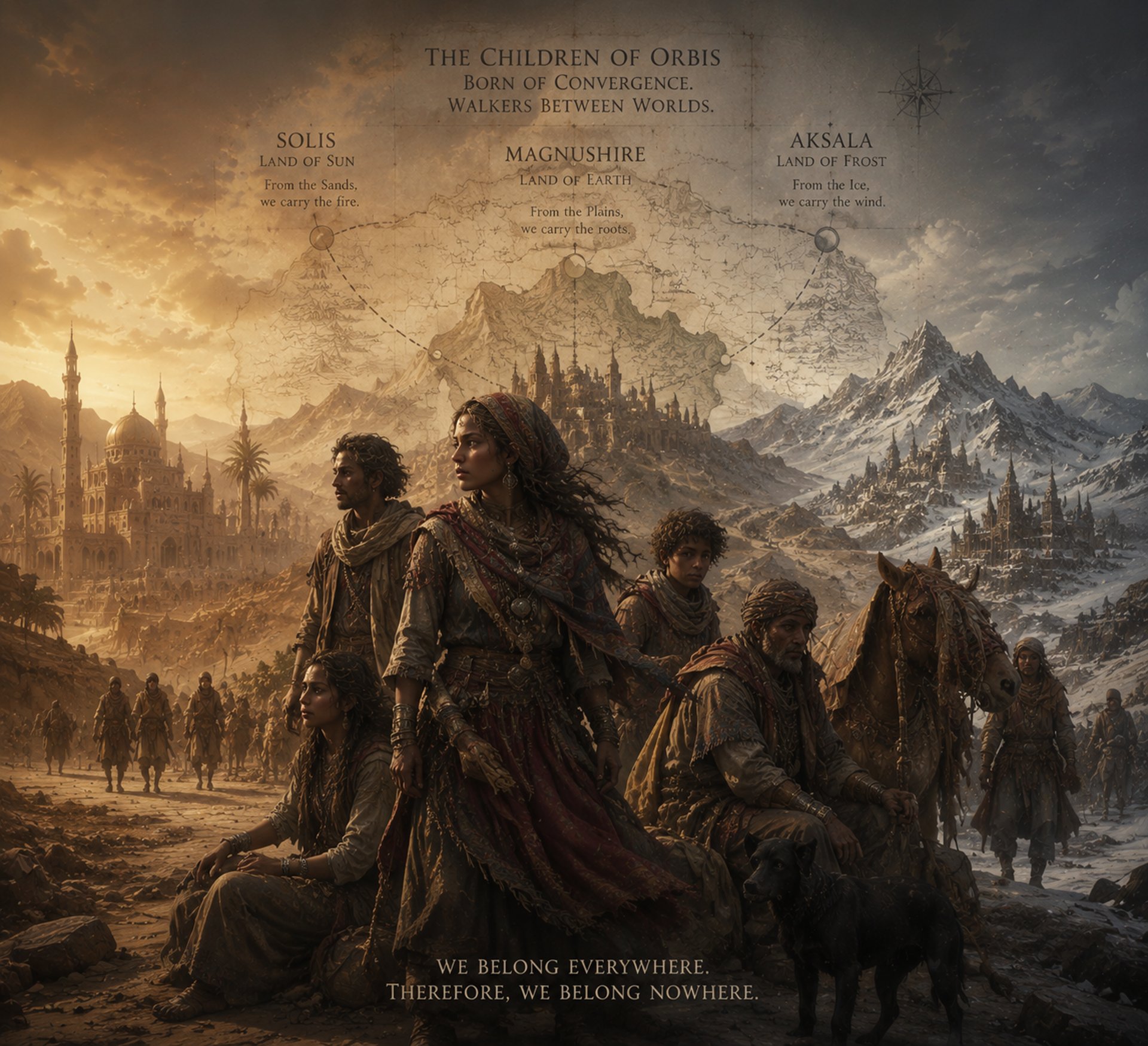
To understand the Travellers, you have to wind the clocks back six to eight hundred years. Long before Vortigen slaughtered the midland royals, and long before the Emperor of Solis sealed his people behind the Golden Gates, the borders of Orbis were porous. The tundra lines stretched differently, and the world was defined by movement rather than fear.
The ancestors of the Travellers were not born in the high peaks or the deep deserts. They were born in the bustling Trade Hubs of the Old Midlands. Because Magnushire sits squarely in the centre of the continent, it acted as the natural, unavoidable melting pot of Orbis.
The Synthesis of Blood and Soil
During this golden era of open borders, the Old Midlands saw a massive, continuous clash of cultures:
The North: Pale-skinned, elemental-worshipping nomads descended from the Aksalan peaks, bringing thick furs and sky-metals.
The South: Deep-complexioned, sun-worshipping merchants traveled up from Solis, carrying rare spices, silks, and desert glass.
The Center: They met in the fertile plains of Magnushire, trading heavily with the agrarian, bone-worshipping locals.
Over generations of intermingling and intermarriage in these central hubs, a distinct new demographic emerged. They were a perfect biological synthesis of the continent. They inherited the rich melanin of the South—making their skin significantly darker than the midland farmers, though slightly lighter than the pure, sun-baked Solians—and combined it with the rugged, stocky resilience required to survive the freezing North.
Masters of the In-Between: Why They Walked Away
They didn't start as outcasts; they began as the ultimate middlemen. Because they possessed family ties, cultural fluencies, and physical traits that belonged to all three regions, they naturally became the dedicated merchants of Orbis.
Their bodies were perfectly adapted for the continent's extremes. Their darker skin allowed them to handle the blistering Solian sun without burning, while their stocky, hardy frames kept them from freezing to death in an Aksalan blizzard.
However, because they were a blend of everywhere, they didn't fit perfectly anywhere. They were too restless for the sedentary farming villages of Magnushire, too diverse for the strict, hyper-traditional city structures of Spectre Grove, and too cosmopolitan for the isolated, survivalist clans of the ice. So, they simply stayed on the move, carving out a life in the spaces between the nations.
The Great Amnesia: When History Fades to Myth
Time is the greatest eraser of truth. Over three centuries, as these people lived, married, and died exclusively within their traveling caravans, their literal origins faded into the fog of history.
From Genetics to Folklore Today, the Travelers have entirely forgotten that their skin tone is a genetic cocktail of ancient Solian, Magnic, and Aksalani blood. Instead, they developed their own beautiful, insular cultural myths to explain their existence.
When asked why they look different from the pale men of the snow or the dark men of the sand, a Traveller will tell their children that their skin is "the color of the earth—baked by the sun and cooled by the frost." It is a poetic sign that they belong to the whole continent, rather than any single kingdom.
Linguistic Drift Their language suffered a similar fate. They lost the pure Sahrani of their southern ancestors and the pure ancient Magnic of the midlands. Over hundreds of years on the road, they blended the two into their own unique, fluid dialect—a rolling, rhythmic version of Magnic that still carries the ghosts of Sahrani syntax in their accents.
The Modern Tragedy: The Ironies of Orbis
When you view the deep history of the Travelers, the current state of Orbis transforms from a simple geopolitical conflict into a deeply poetic tragedy. The modern borders of the world have turned the Children of Orbis into hunted strays.
The Irony in Solis: Following the brutal Reclaimer invasion twenty years ago, a faction of Travelers was trapped inside Spectre Grove when the Golden Gates slammed shut. Today, the xenophobic Solians treat these trapped nomads as "unclean foreigners" and force them into low-caste labor. The Solians are so blinded by trauma that they cannot see they are enslaving their own distant cousins—people who carry ancient Solian blood in their veins.
The Irony in Magnushire: In the midlands, Vortigen’s regime viciously persecutes the Travelers. His Iron Guard hunts them down, brands them as "pagan outsiders," and forces them into high-risk smuggling just to survive. The General completely ignores the historical reality that it was the Travellers' ancestors who built the midland trade routes that his empire now relies on.
They possess a piece of the North, the South, and the Midlands. They are the only true "Children of Orbis"—yet because the world has fractured into paranoia, isolationism, and tyranny, they are hated by every single side.
They belong everywhere. And because of that, modern borders ensure they belong nowhere.