Renegade coming 22nd August 2026 — Pre-order on Amazon!

Why the Word "Lady" Always Made Me Shudder: Navigating Life, Teaching, and Finding My Identity
I’m autistic, non-binary, and learning to thrive outside the binary. Explore how my neurotype shapes my gender and why authenticity is the heart of my story.
ADVOCACY & IDENTITY
C. Pintilie
5/28/20264 min read
For as long as I can remember, I never identified with being girly. I didn’t just feel like I was bad at being a girl; I fundamentally didn't resonate with the concept. If you wanted to see me physically cringe as a kid, all you had to do was call me a "lady." That word actively made me shudder. It felt like a costume someone was trying to force me into, and it never, ever fit.
For a long time, my outward expression reflected that disconnect. I aggressively avoided dresses and skirts. I rocked short hair on and off well into my mid-twenties. It wasn’t until my late twenties that I actually started to get into hair and makeup. And honestly? Discovering those things later in life, on my own terms, didn't make me any more of a "lady." It just meant I finally felt secure enough to play with presentation without it defining my gender.
My identity isn't a rigid box; I am non-binary.
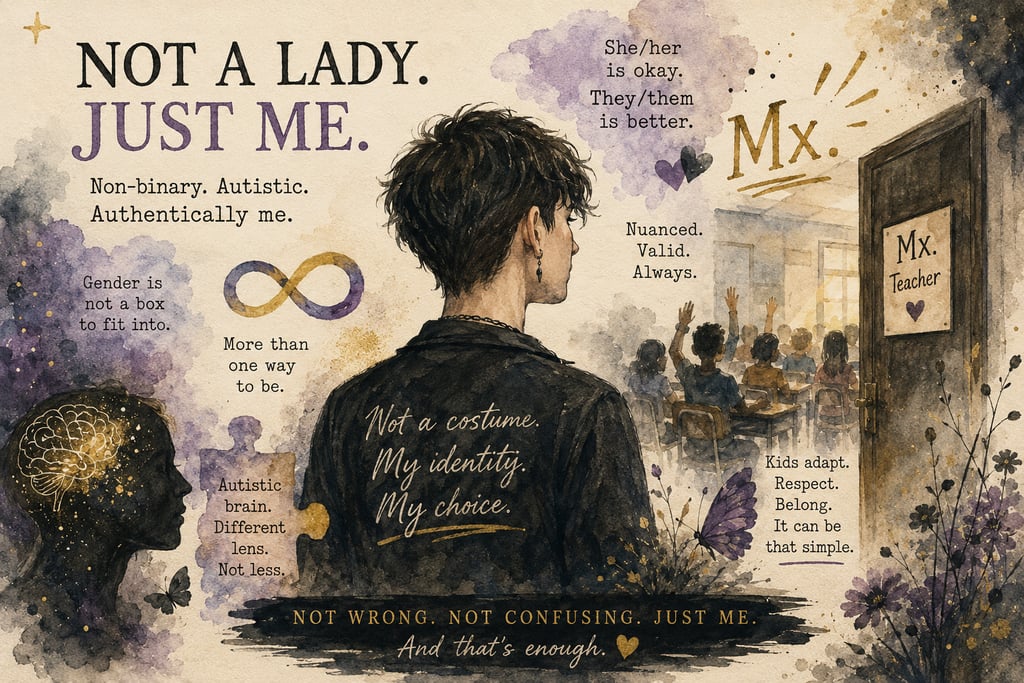
For as long as I can remember, I never identified with being girly. I didn’t just feel like I was bad at being a girl; I fundamentally didn't resonate with the concept. If you wanted to see me physically cringe as a kid, all you had to do was call me a "lady." That word actively made me shudder. It felt like a costume someone was trying to force me into, and it never, ever fit.
For a long time, my outward expression reflected that disconnect. I aggressively avoided dresses and skirts. I rocked short hair on and off well into my mid-twenties. It wasn’t until my late twenties that I actually started to get into hair and makeup. And honestly? Discovering those things later in life, on my own terms, didn't make me any more of a "lady." It just meant I finally felt secure enough to play with presentation without it defining my gender.
My identity isn't a rigid box; I am non-binary.
The Pronoun Nuance
When it comes to pronouns, people often expect a strict binary even outside the gender binary. For me, it is a bit more relaxed. I don't mind she/her, but I definitely prefer they/them.
Sometimes, people struggle to wrap their heads around that flexibility. They think if you don't strictly enforce one specific pronoun at all times, your identity is up for debate. It isn't. It just means my relationship with gender is nuanced, and I am comfortable existing in that gray area.
The Intersection: How My Autistic Brain Shapes My Gender
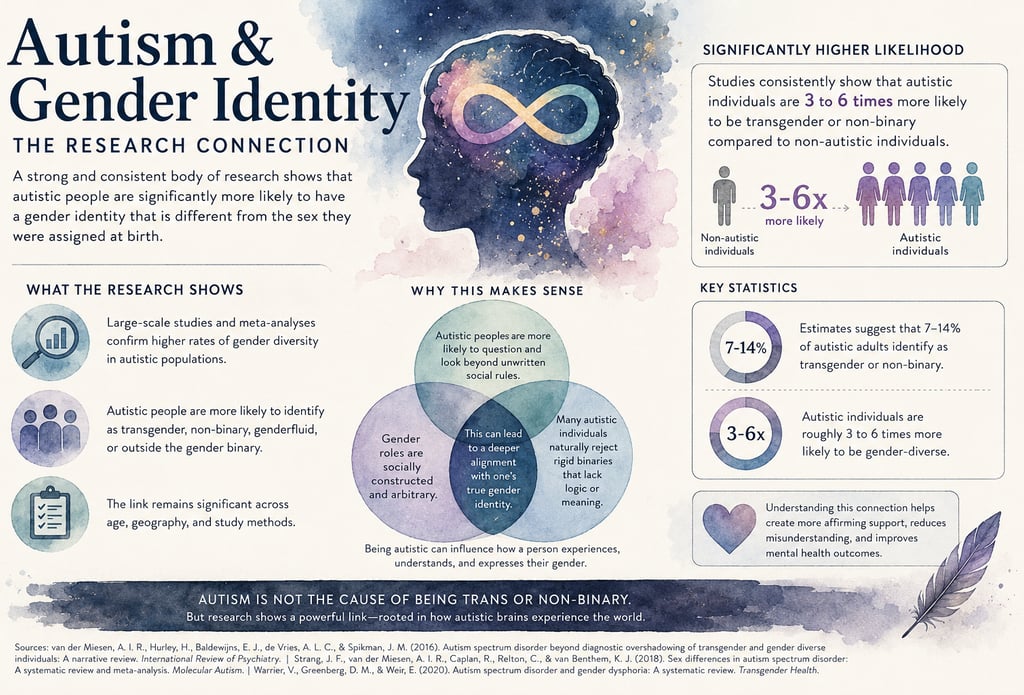
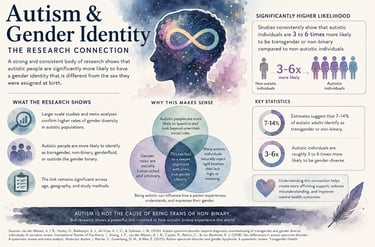
There is also a massive piece of the puzzle that explains why I view the world this way: I am also autistic. For a long time, I viewed these as two separate parts of who I am, but the reality is that our neurotype heavily influences how we experience gender. Research actually backs this up in a huge way. Studies show that autistic and neurodivergent individuals are significantly more likely to identify as non-binary or transgender compared to the general population. In fact, if you do not identify with the sex you were assigned at birth, you are roughly 3 to 6 times more likely to be autistic.
When you think about how the autistic brain works, this link makes total sense. Autism often comes with an innate tendency to look right past unwritten social rules and arbitrary constructs. Because the gender binary is a strict social norm, many autistic individuals simply do not relate to or conform to traditional male or female roles. If a social rule doesn't make logical sense, our brains don't feel compelled to follow it.
Within the community, there’s even a term for this: autigender. It describes an identity where your autism and your gender are so deeply intertwined that they cannot be separated. My autism is the lens through which I see everything, including my own body and identity.
Of course, living at this intersection brings unique mental health challenges. Navigating a world that wasn't built for neurodivergent people or gender-diverse people can be incredibly isolating and exhausting. It highlights just how vital it is to have genuinely affirming care, understanding, and spaces where we don't have to mask who we are.
Subscribe for updates on The Legends of Iron Spine
No spam; only one monthly email.
Finding "Mx" in the Classroom
One of the biggest hurdles of stepping into my authentic self was navigating my professional life—specifically, as a teacher.
Schools are institutions built on tradition and rigid binaries. The entire day is structured around "Sir" and "Miss." Stepping into a classroom and asking to be called something else entirely is an incredibly daunting experience. It took me a while to build up to it. In fact, it wasn't until my third school that I finally gathered the courage to introduce myself as Mx. It was a leap of faith. Kids, surprisingly, are usually fantastic about it. They adapt quickly, ask straightforward questions, and move on. It is the adults who tend to make it complicated.
Genuine Questions vs. Bad-Faith Debates
Living openly as an autistic, non-binary person means you often become an unwilling sounding board for other people's opinions.
I am always incredibly open to answering questions when they are genuine. If someone is truly trying to understand my experience or learn how to be respectful, I have all the time in the world for them.
Unfortunately, that isn't always what happens. Some people frame their judgment as "just asking questions," when in reality, they are trying to tell me I am wrong based entirely on their own rigid standards. Others will claim to accept it, but still actively poke fun at the terms or roll their eyes at the language. That kind of subtle disrespect is exhausting.
Setting the Standard
I am sharing this now because this blog—and the writing I do—is about authenticity. You cannot write honest stories if you are hiding the lens through which you view the world. Being non-binary, being autistic, existing outside the expected lines, and learning to advocate for myself are all core parts of who I am.
I am so grateful to be at a point where I know exactly who I am, even if it took me a while to find the vocabulary for it.